Workforce Planning: Separating Hiring Pressure From Turnover
In brief
A workforce decision framework that distinguishes open roles, completed hiring, voluntary quits, and total separations.
Executive summary
Business problem: determine whether workforce pressure comes from growth, hiring friction, or employees leaving.
Key findings: open roles are demand rather than completed hiring; quits are different from total separations; and the December 2025 U.S. aggregate shows 6.55m openings alongside 5.203m total separations.
Business impact: the same headline “staffing problem” can require recruiting, retention, workforce-design, or cost action.
Recommended action: use JOLTS as external context and connect it to internal vacancy age, time-to-fill, tenure, and exit data.
Decision frame and KPI tree
Decision owner: Chief People Officer. Decision: where should workforce investment go first? North-star KPI: critical-role coverage. Drivers: openings, hires, time-to-fill, quits, separations, tenure, and productivity. Guardrails: labor cost, overtime, quality, burnout, and regretted attrition.
Baseline and diagnostic logic
The BLS API returned December 2025 values of 6.55m openings, 3.3% hires, 2.0% quits, and 5.203m total separations. Openings measure employer demand; hires measure people starting; quits measure employee-initiated exits; total separations include other exit types.
The data cannot identify a company, team, manager, or role causing turnover. It is also an aggregate estimate that can be revised. Any internal diagnosis must preserve that distinction.
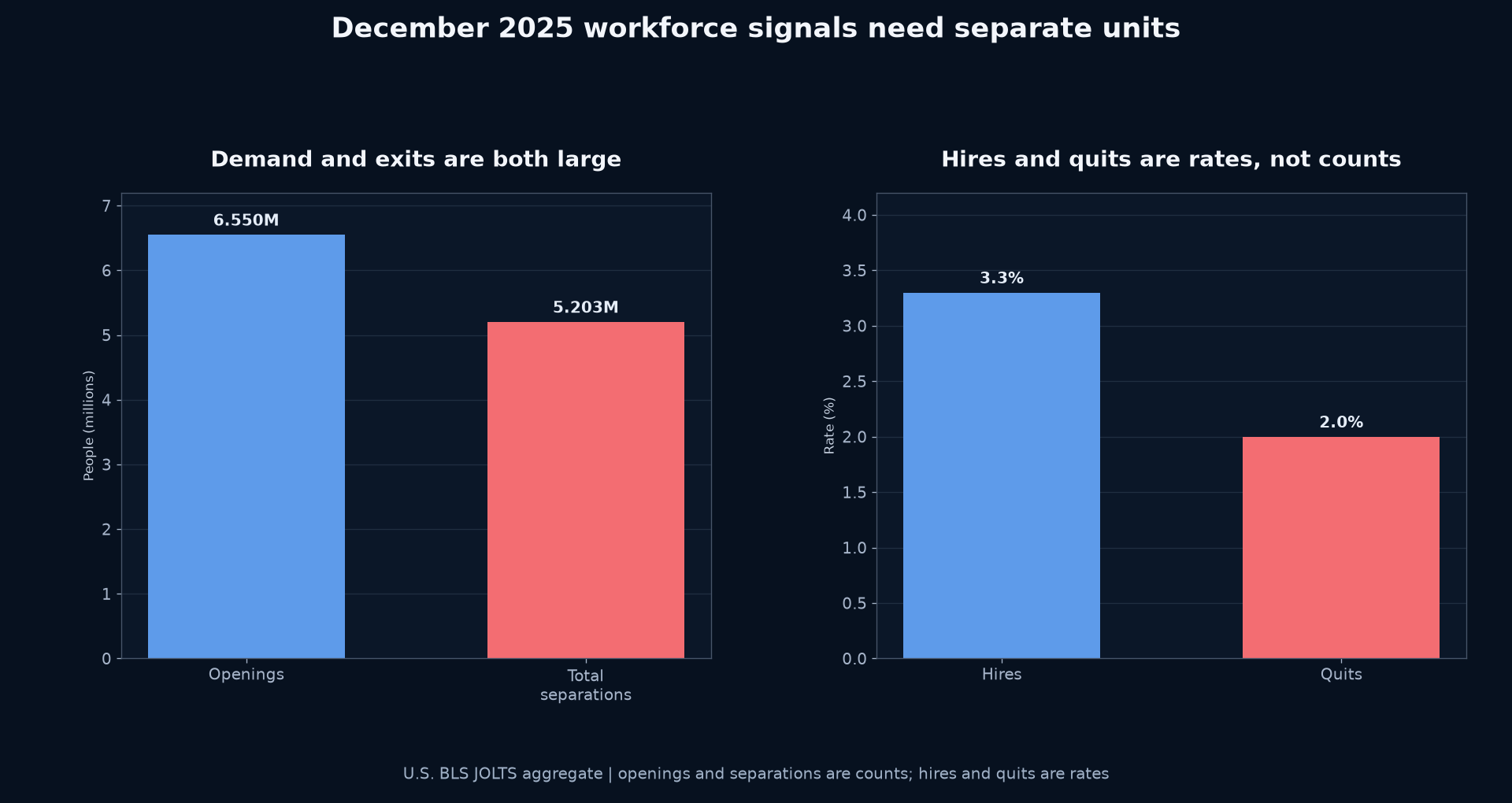 Chart takeaway: U.S. BLS JOLTS, December 2025: 6.55M openings, 3.3% hires, 2.0% quits, and 5.203M total separations measure different workforce signals
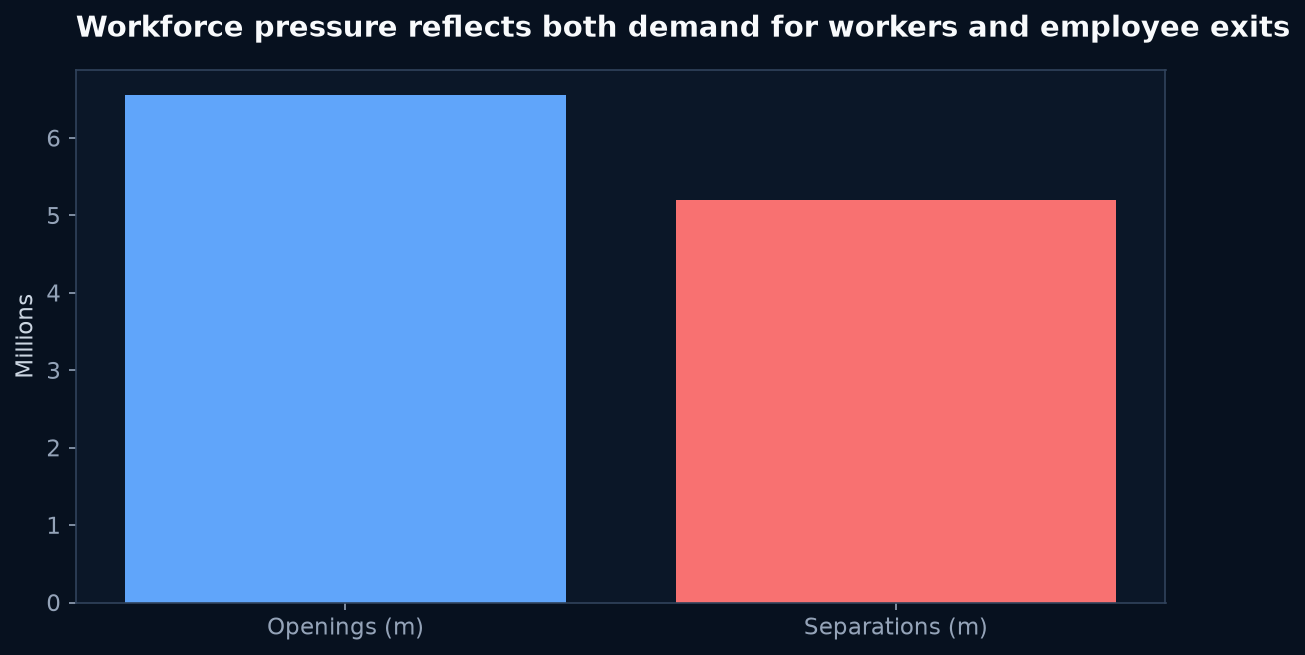 Chart takeaway: U.S. BLS JOLTS, December 2025: Workforce pressure reflects both demand for workers and employee exits
Opportunity, trade-offs, and scenarios
The conservative scenario is to improve vacancy visibility and recruiting throughput in critical roles. The expected scenario combines that with targeted retention work where internal quits exceed the external benchmark. The ambitious scenario redesigns roles or staffing models. Faster hiring can improve coverage but increase cost or reduce selection quality; retention programs can add cost without reducing regretted exits.
Prioritized plan and measurement
- P0 — Act now: build one scorecard for openings, hires, time-to-fill, quits, and regretted exits.
- P1 — Test: pilot a retention or recruiting intervention in one role family with a comparable control group.
- P2 — Investigate: join internal HR data to pay, tenure, manager, location, and workload measures.
Primary metric is critical-role coverage; guardrails are quality, overtime, labor cost, employee experience, and regretted attrition. Repeat with revised BLS data and alternative time windows.
Takeaway
JOLTS does not explain a company’s people problem. It improves the decision by separating labor-market context from internal root causes, so management can act on the drivers it can control.
Supporting detail
Source: BLS JOLTS. The series is an aggregate U.S. labor-market indicator and should not be used for individual employment decisions.