Credit Default Risk: Prioritizing Support Before Losses Grow
In brief
A transparent risk-prioritization study that combines repayment history and exposure while keeping fairness, drift, and support outcomes visible.
Executive summary
Business problem: prioritize early support and monitoring across a credit portfolio.
Key findings: repayment history is closer to the risk decision than demographics alone; exposure changes the size of a potential loss; and the 2005 Taiwan sample lacks current economics, fairness fields, collection cost, and hardship outcomes.
Business impact: a transparent review queue could focus limited support capacity, but a model could create customer harm if used without current validation and governance.
Recommended action: use group-level risk tiers for review and support experiments, not automatic approval or rejection.
Decision frame and KPI tree
Decision owner: Credit Risk Director. Decision: which accounts or groups need earlier review or support? North-star KPI: avoidable loss after support cost. Drivers: repayment history, balance, credit limit, utilization, and payment behavior. Guardrails: approval rate, false positives, fairness, customer hardship, and complaints.
Baseline, segmentation, and root-cause logic
The official file has 30,000 rows and 24 fields. The useful business decomposition is risk signal × exposure: two accounts with similar observed default risk can create different potential losses when their balances or credit limits differ.
Repayment history should be the first diagnostic layer. Age, education, and other demographic fields may help describe segments, but they should not become a shortcut for a lending decision. The data is observational and historical, so association is not causation.
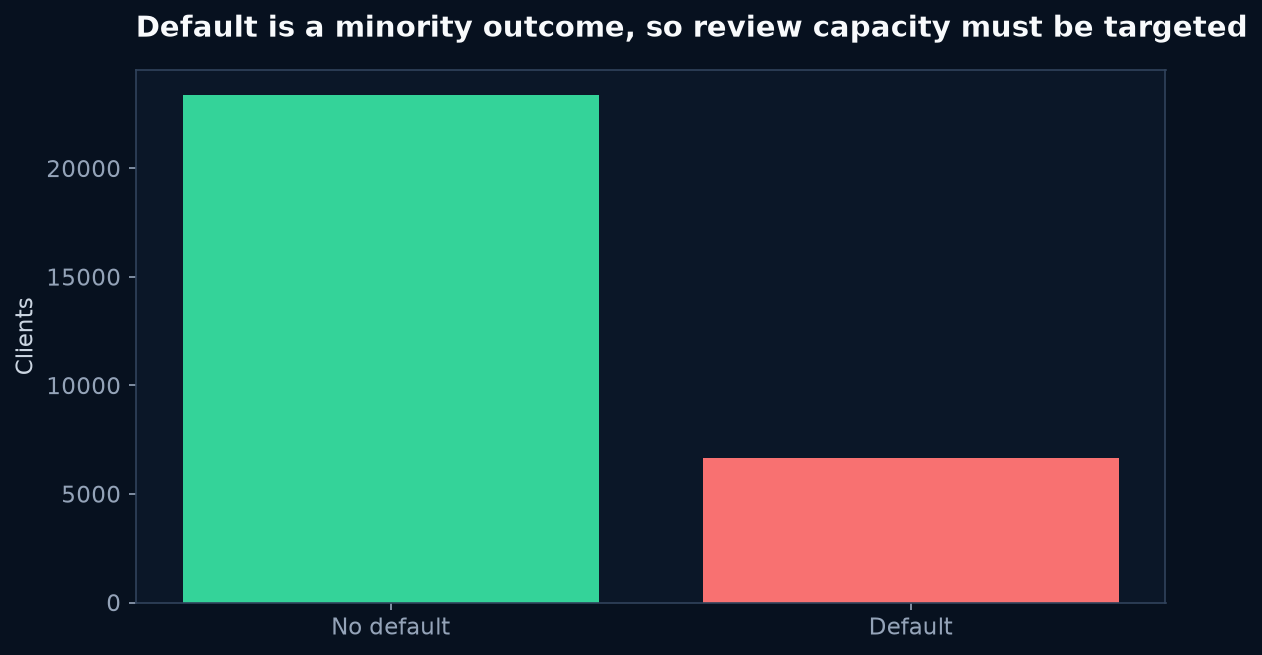 Chart takeaway: UCI Taiwan credit-client sample, 30,000 accounts from 2005: Default is a minority outcome, so review capacity must be targeted
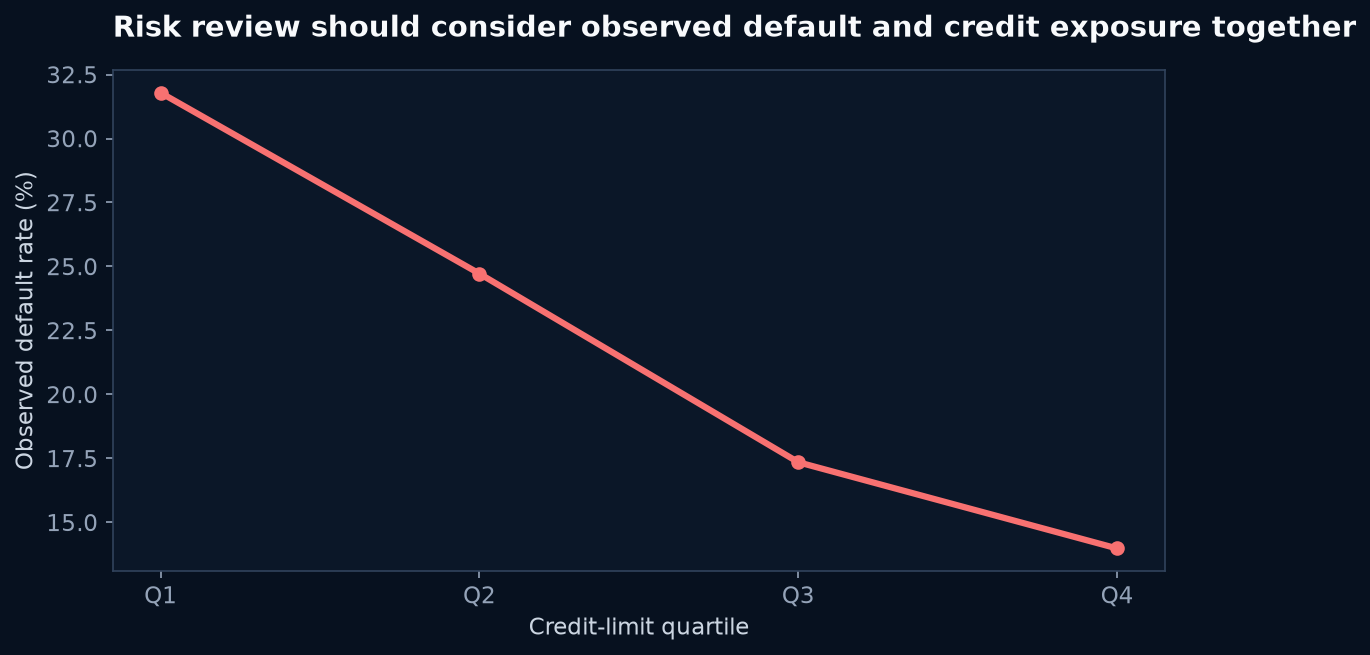 Chart takeaway: UCI Taiwan credit-client sample, 30,000 accounts from 2005: Risk review should consider observed default and credit exposure together
Opportunity, trade-offs, and validation
The conservative scenario is a manual review queue for high-risk/high-exposure accounts. The expected scenario adds early payment support and measures avoided delinquency. The ambitious scenario adds current income, hardship, collection cost, and outcome data. Removing risky customers may reduce loss but also reduce revenue and access to credit.
- P0 — Act now: define transparent risk tiers and review outcomes.
- P1 — Test: offer support to a randomized eligible group against standard treatment.
- P2 — Investigate: validate current performance, fairness, drift, and cost before any automated decision.
Primary metric is net loss after support cost; guardrails are false-positive rate, approval/access outcomes, complaints, and fairness by protected group. Repeat with alternative exposure definitions and excluding extreme limits.
Experiment and measurement plan
Target accounts with recent repayment stress and meaningful exposure. Treatment is early support or a payment-plan offer; control is standard communication. Measure delinquency/default, repayment completion, support cost, complaints, and downstream customer value. A result is decision-ready only if it improves net loss without unacceptable fairness or hardship effects.
Takeaway
Senior risk work is not just predicting default. It connects risk evidence to exposure, support capacity, customer outcomes, and governance before deciding who receives attention.
Supporting detail
Source: UCI Default of Credit Card Clients, CC BY 4.0. The source is historical and cannot support a current lending policy on its own.