Multi-Site Operations: Prioritize Continuity Planning by Hazard and Footprint
In brief
A county-level FEMA and Census screen finds where large retail, food-service, and manufacturing footprints overlap with higher relative hazard risk.
Business question
Which U.S. counties should multi-site operators investigate first when a large local business footprint overlaps with higher natural-hazard risk?
Why it matters
A continuity team may need to choose where to test alternate suppliers, backup power, staffing, and recovery plans. County-level evidence can narrow the review list, but it cannot identify the exposure of an individual facility.
Decision brief
- Recommendation: use FEMA county ratings to create a continuity review queue, then geocode actual sites and evaluate hazard-specific exposure before changing investments or operating plans.
- Evidence: 179 high or very-high composite-risk counties contained 48.4% of the tracked retail establishments, 52.4% of accommodation and food-service establishments, and 46.2% of manufacturing establishments.
- Evidence strength: Moderate for identifying counties where business activity and FEMA's relative community risk ratings overlap; low for estimating company losses or disruption duration.
- Main risk: County Business Patterns counts industry establishments, not a named chain's locations. FEMA's county score is a relative community measure, not a site-level risk estimate.
- Next test: join exact facility coordinates to hazard layers, insurance terms, supplier links, and business-continuity dependencies.
Data used
The Census Bureau's 2023 County Business Patterns provides establishment counts by county and industry. I grouped retail trade from NAICS 44 and 45, accommodation and food services from NAICS 72, and manufacturing from NAICS 31, 32, and 33.
I joined these counts to FEMA's National Risk Index county layer, version 1.20, released in December 2025. FEMA provides composite ratings and hazard-specific ratings, including hurricanes, inland flooding, and wildfire. The two sources describe different periods: 2023 business counts and 2025 risk data.
Analysis
Composite high-risk counties contain a large share of establishments
FEMA's High and Very High composite risk classes covered 179 counties with matching business counts. These counties held 504,642 of 1,043,104 retail establishments (48.4%), 410,822 of 784,735 accommodation and food-service establishments (52.4%), and 131,363 of 284,156 manufacturing establishments (46.2%).
The overlap is substantial, but it is not a risk rate per business. Large counties tend to contain more establishments and more exposed assets. A high county score and a large business footprint therefore flag review priority, not the loss expected at each establishment.
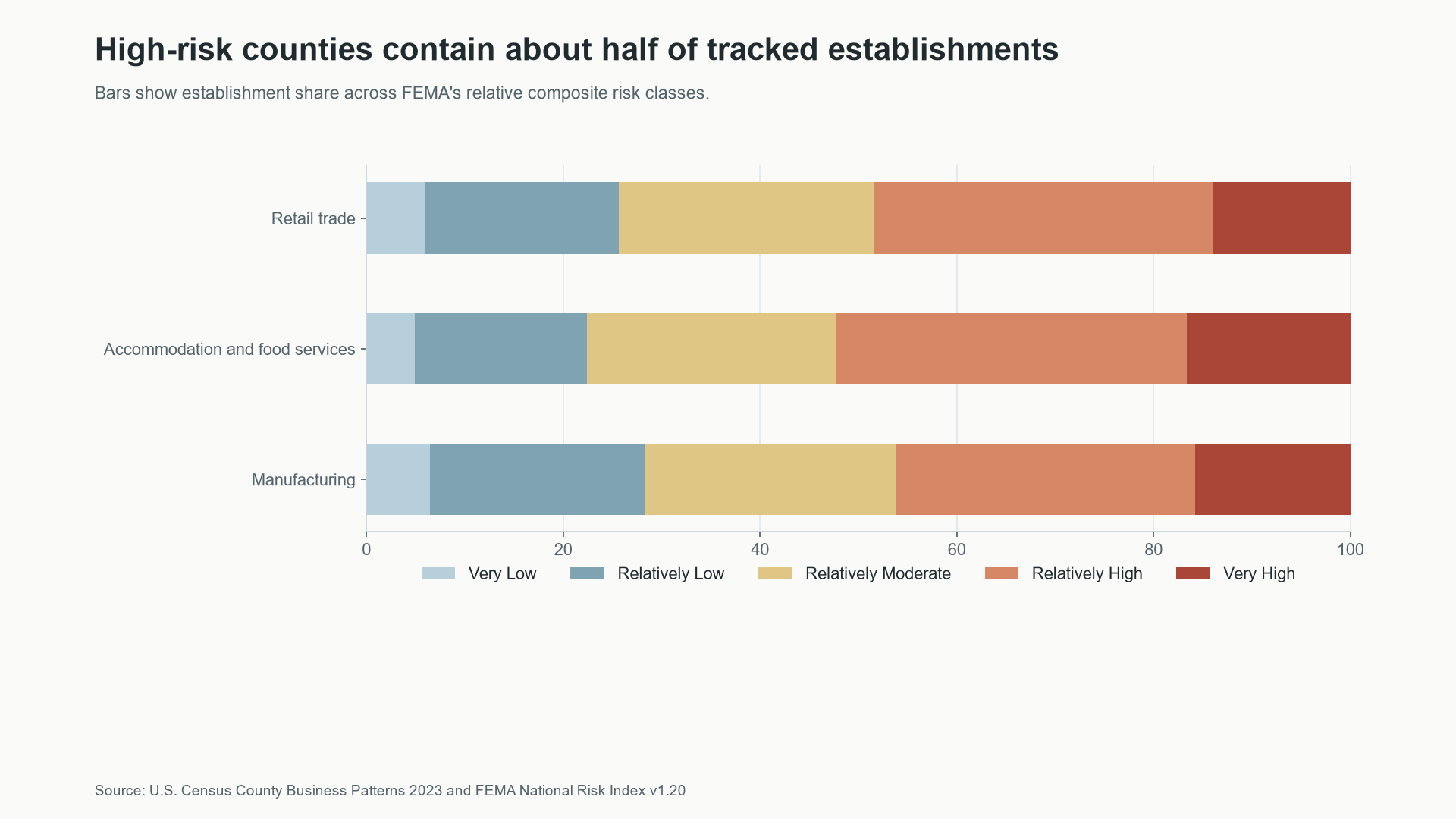 Scroll horizontally to inspect chart labels.Chart takeaway: Share of retail, accommodation and food-service, and manufacturing establishments by FEMA composite risk rating
Hazard-specific screens produce different priorities
Among establishments in counties with an applicable FEMA hazard rating, the share in high or very-high inland-flood counties was 53.1% for retail, 57.4% for accommodation and food services, and 51.8% for manufacturing. The corresponding hurricane shares were 27.1%, 27.3%, and 20.7%. Wildfire shares ranged from 12.6% to 14.5%.
Hurricane ratings covered 73.3% to 77.1% of sector establishments. Inland-flood and wildfire ratings covered more than 99.9%. I excluded unrated and not-applicable counties from each hazard denominator. These comparisons show why one composite score should not replace hazard-specific review.
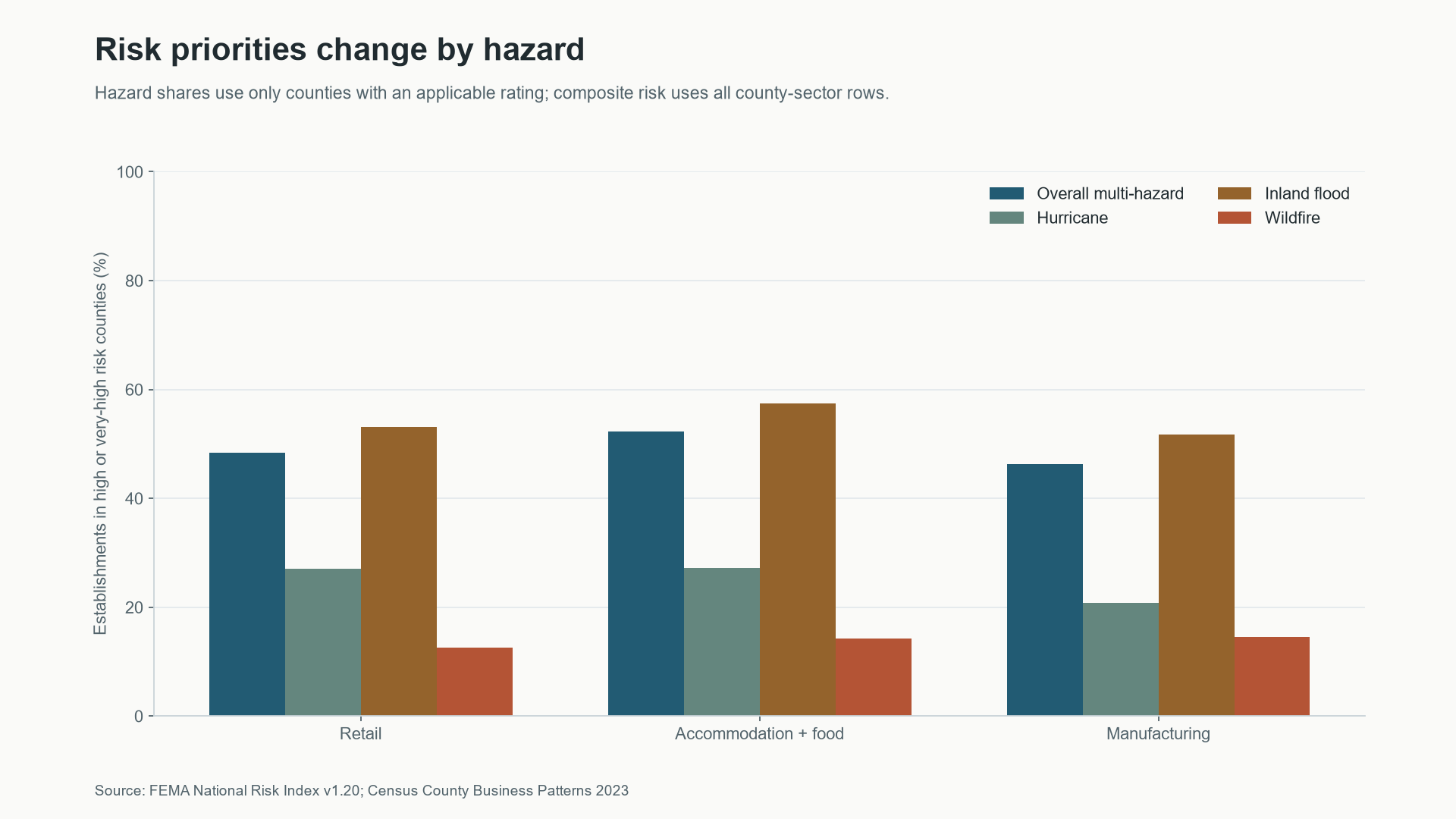 Scroll horizontally to inspect chart labels.Chart takeaway: Share of establishments in high or very-high counties by FEMA composite, hurricane, inland flood, and wildfire ratings
County priorities depend on both operating footprint and risk class
Los Angeles County had 28,998 retail establishments, 25,110 accommodation and food-service establishments, and 10,122 manufacturing establishments. It also had the maximum FEMA composite risk score of 100. Other large county-sector footprints in high or very-high counties included Harris County, Texas; Cook County, Illinois; and Maricopa County, Arizona.
These places are candidates for detailed continuity reviews, not automatic relocation decisions. A national ranking can obscure facility-level variation within each county.
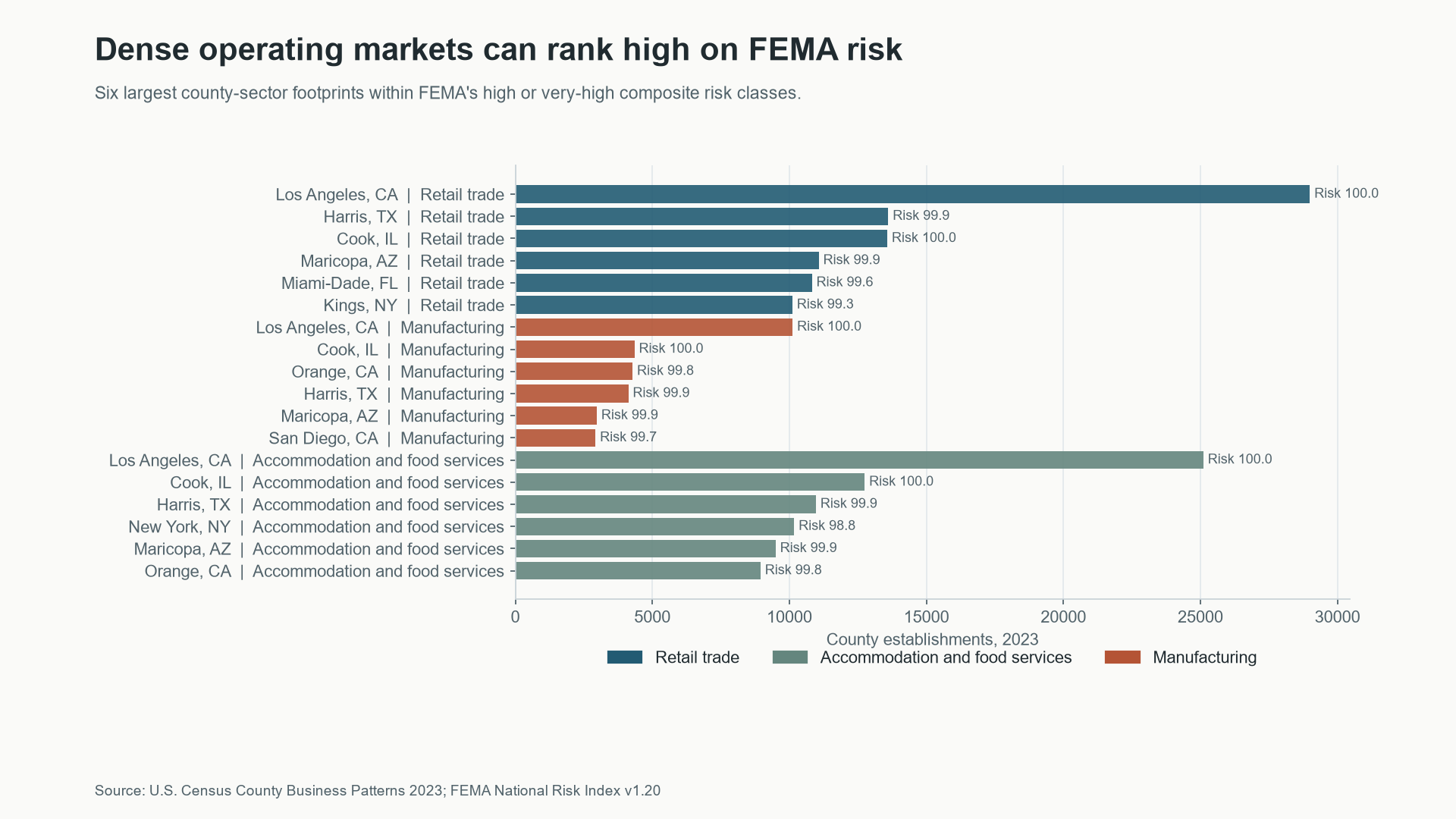 Scroll horizontally to inspect chart labels.Chart takeaway: Largest retail, accommodation and food-service, and manufacturing footprints in counties with high or very-high FEMA composite risk
Result - use the screen to queue facility reviews
The evidence supports prioritizing county-level continuity reviews, with inland flooding first in this broad sector screen. The result does not estimate a particular operator's expected loss, insurance premium, downtime, or mitigation return.
For a real network, the decision should use exact facility locations and operating dependencies. Review sites against hazard-specific maps, supplier concentration, transport access, backup capacity, and recovery plans. Test scenarios before reallocating sites or capital.
Technical notes
I aggregated non-overlapping Census industry group codes to county totals. I removed records with an unknown county FIPS code, then validated a one-to-one county join against the FEMA layer. The analysis reports both FEMA's High or Very High categories and a sensitivity screen using the upper quartile of the composite score within each sector's matched counties. The latter contains 75.8% to 82.1% of sector establishments, showing that a planning queue changes with the selected cutoff.
Hazard-specific establishment shares use counties with applicable ratings as denominators. The source labels No Rating, Not Applicable, and Insufficient Data separately. I do not treat those categories as low hazard.
The FEMA National Risk Index technical documentation describes the county risk methodology. The local source snapshots, hashes, validation checks, and regeneration command are recorded in the evidence manifest. The manifest identifies the public source version used.