College Program Outcomes: Check Coverage Before Comparing Earnings
In brief
A coverage audit of federal program outcomes finds that reportable earnings vary sharply by credential and institution type, making unqualified program rankings unsafe.
Executive summary
Decision: can a college use public program earnings to decide where to invest or what to promote? Finding: after removing repeated branch-campus records, only 37.6% of domestic bachelor's program records in the June 2026 College Scorecard file had a reportable four-year earnings median. Coverage was 54.2% for public programs and 24.8% for private nonprofit programs. Recommendation: show coverage beside every comparison and use reported outcomes as a review signal, not a ranking. The data does not represent every graduate or explain why outcomes differ.
Problem - a clean ranking can hide missing outcomes
College leaders may compare majors or institutions using public earnings figures. If some programs have no reportable value, a ranking can describe only the visible part of the portfolio and make the coverage gap hard to see.
The business question is: is the College Scorecard field-of-study file complete and comparable enough to guide a program review, and what should leaders check before acting on it?
Hypotheses - what could make comparisons misleading?
- Suppression may leave many programs out of view. Count reportable earnings and privacy-suppressed cells separately.
- Coverage may differ by credential or institution type. Compare like-for-like program records before interpreting the visible values.
- Branch campuses may repeat the same outcome value. Check the source's institution key before counting programs or comparing coverage.
Analysis - how much of the program picture is visible?
The source is the U.S. Department of Education's College Scorecard Most Recent Cohorts: Field of Study file, released on June 10, 2026. It contains 227,980 rows with earnings, debt, institution, field-of-study, and credential data. The unit for these outcome measures is the institution system, four-digit Classification of Instructional Programs field, and credential level.
The Department calculates some outcome measures at the six-digit OPEID institution-system level and repeats them across branch campuses. I verified that repeated earnings and debt values matched, then kept one row per OPEID6, field, and credential. For the comparison below, I excluded foreign institutions and non-credential coursework. I treat a numeric median as reportable and keep the source's PS privacy-suppression value separate. In the domestic bachelor's rows, every nonnumeric earnings cell is marked PS.
Earnings coverage changes by credential
Only 37.6% of the distinct domestic bachelor's program records report a four-year earnings median. Coverage also varies across credential levels, so each comparison needs its own coverage count.
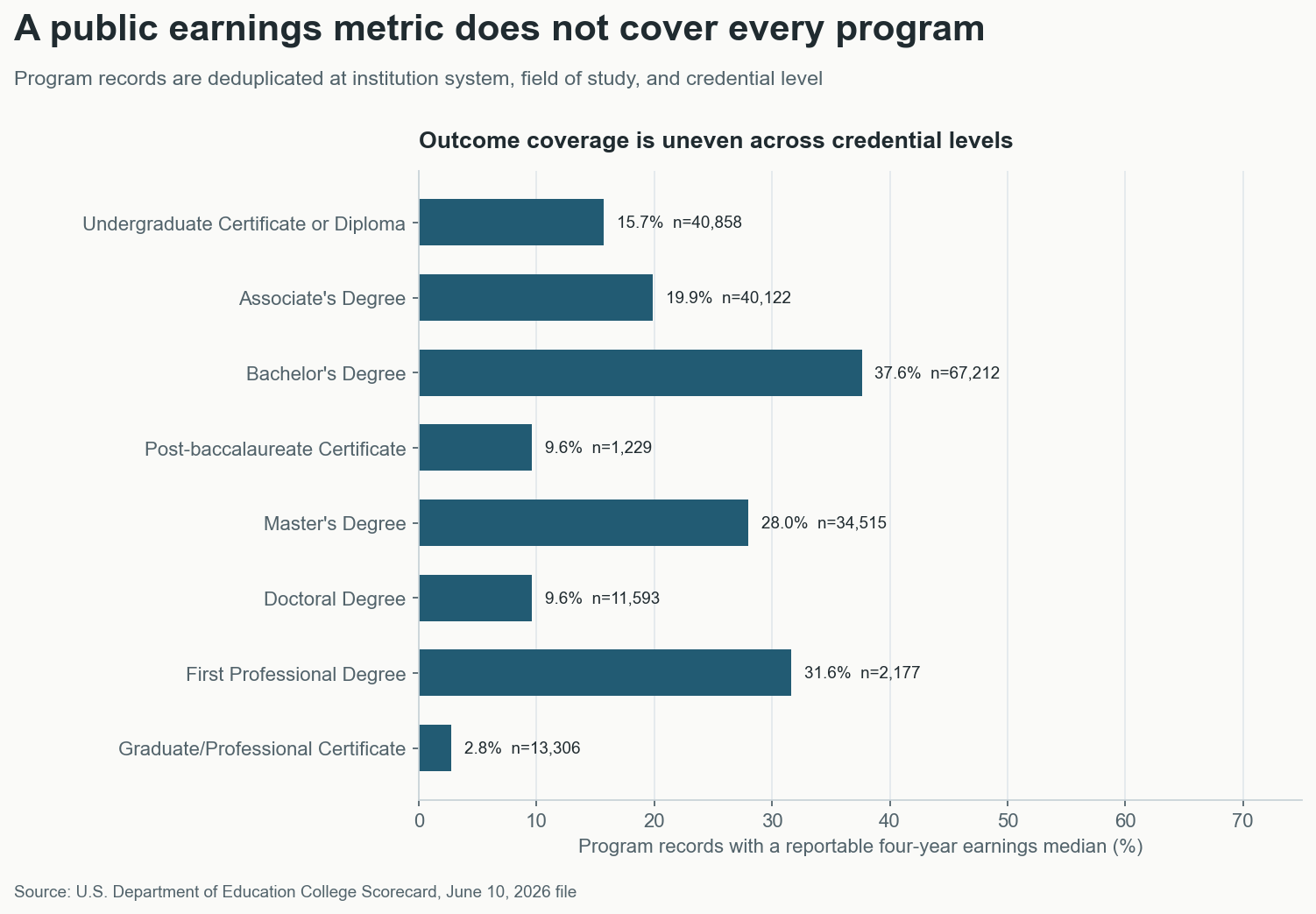 Scroll horizontally to inspect chart labels.Chart takeaway: Share of College Scorecard program records with a reportable four-year earnings median by credential level
This means the absence of an earnings value cannot be read as a low outcome or a zero. It is a coverage condition that must stay visible in a decision dashboard.
Public programs are more visible than private nonprofit programs
Among domestic bachelor's program records, 54.2% of public programs had a reportable median, compared with 24.8% of private nonprofit programs and 44.5% of private for-profit programs. This describes reporting coverage in the file. It does not show that one institution type has better student outcomes.
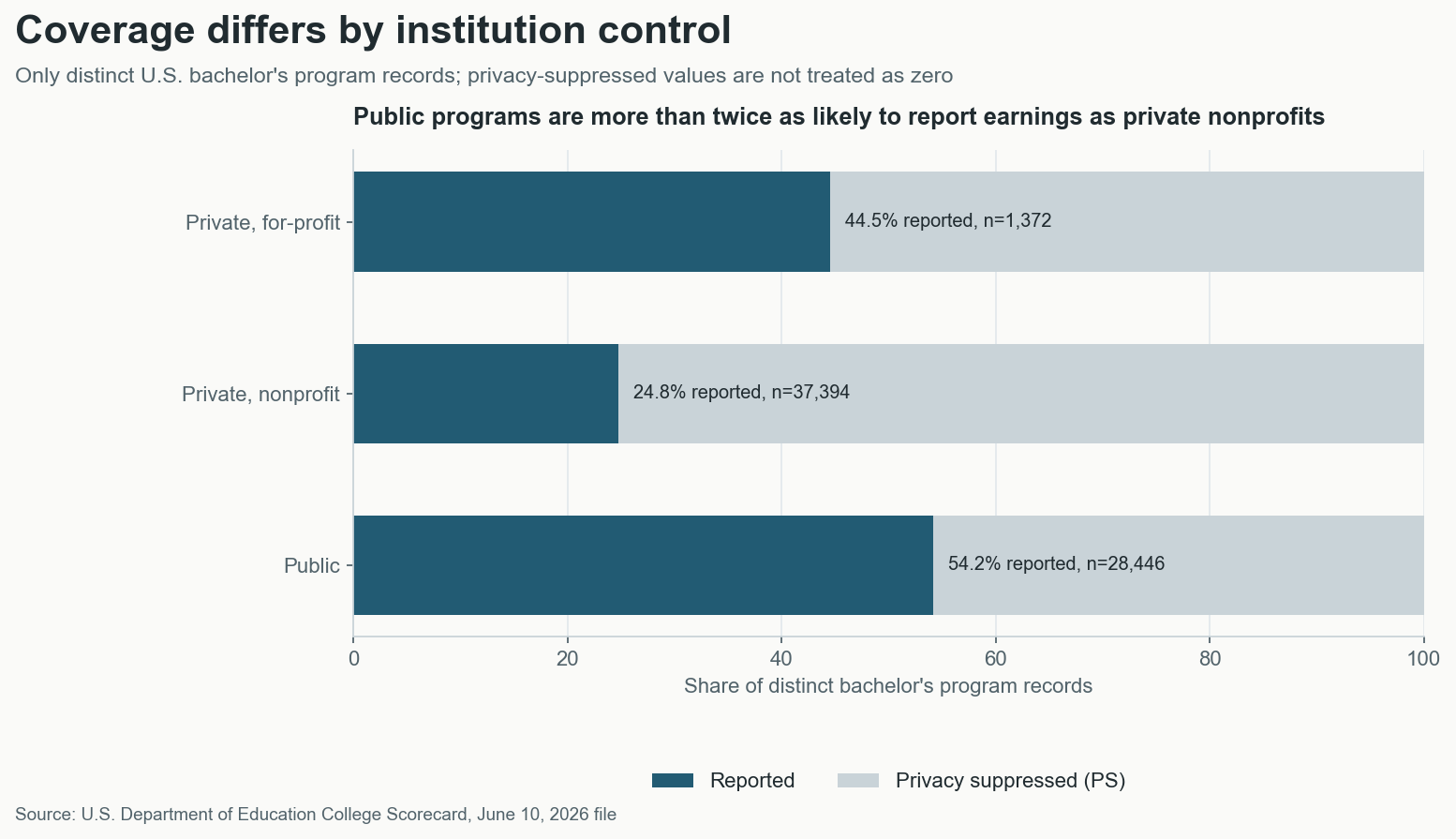 Scroll horizontally to inspect chart labels.Chart takeaway: Reported versus privacy-suppressed PS four-year earnings values in domestic bachelor's program records by institution control
Because coverage differs by institution type, a comparison of visible medians could over-represent groups with more reportable cells. The source does not provide the value for each suppressed cell.
Branch rows need to be collapsed before counting programs
The raw file contains 70,557 U.S. bachelor's rows for the three domestic control groups. After collapsing repeated branch-campus outcomes to distinct institution-system, field, and credential records, 67,212 program records remain. That removes 3,345 repeated rows from this bachelor's comparison.
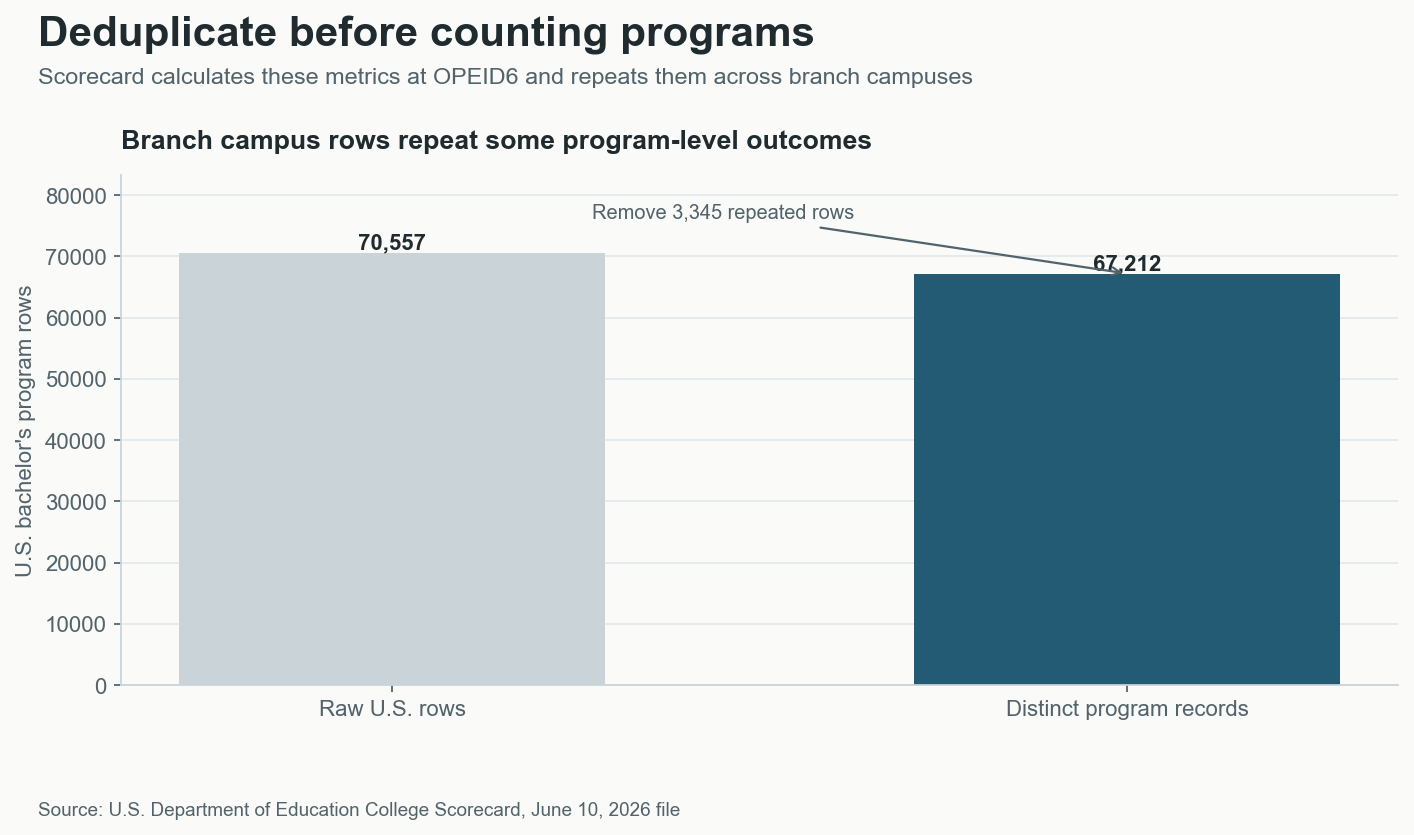 Scroll horizontally to inspect chart labels.Chart takeaway: Raw U.S. bachelor's rows and distinct College Scorecard program records after branch-campus deduplication
The deduplication changes the count, not the reported outcome values. It prevents the same institution-system result from appearing as multiple independent programs just because the institution has multiple campuses.
Result - use program outcomes as a review signal, not a ranking
The coverage and branch-record hypotheses were supported. Most domestic bachelor's program records did not have a reportable four-year earnings median, and coverage varied by institution control. The dataset can support a first-pass review, but it cannot support an unqualified league table across institutions.
- Show reportable and privacy-suppressed counts next to outcome summaries.
- Compare the same field and credential, and keep institution-system records deduplicated.
- Use internal completion, enrollment, debt, cost, and employment data to investigate programs with weak or missing public outcomes.
- Do not treat missing data as zero, infer program quality from coverage, or use these aggregate values as a forecast for an individual student.
Technical notes
The analysis covers the June 10, 2026 field-of-study snapshot. Earnings describe federally aided completers who were working and not enrolled during the measurement year. The values are institution-system, field, and credential medians; they do not include every graduate or provide a causal return on tuition. Privacy-suppressed cells are not imputed. Download instructions, hashes, and regeneration details are in docs/new-public-data-case-notes.md.
Sources: the College Scorecard data download and the Field of Study technical documentation. The data does not establish that a particular institution, major, or policy caused a graduate's earnings.