Amazon Product Search: Can More Fields Improve Relevance Ranking?
Amazon · ESCI · product search · ranking · text matching
Project snapshot
- Built: Compared title-only lexical ranking with a train-tuned score that adds product text fields on query-held-out test data.
- Stack: Python, Polars, PyArrow, NumPy, Matplotlib
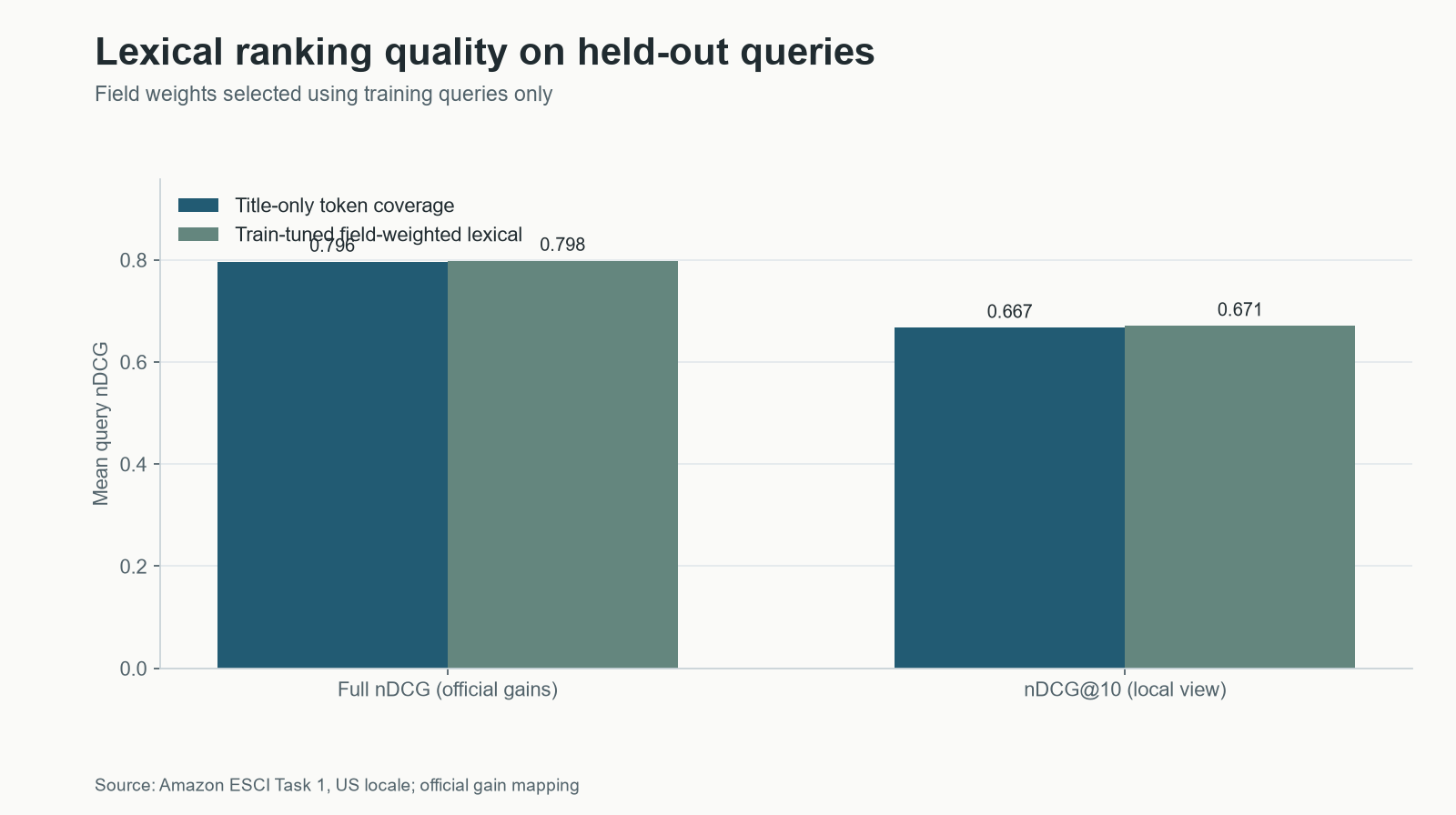
- Result: Full nDCG rose from 0.7965 to 0.7982 on 8,956 held-out queries; the paired-query 95% interval for the gain was 0.0006 to 0.0030.
- Recommendation: Keep title matching as the main signal and test small brand and color weights in a controlled search experiment.
- Code: Analysis script and reproduction steps
Project brief
- Project: Rerank Amazon's public candidate products for each shopping query.
- Question: Do brand, color, bullets, and descriptions improve on title-only lexical matching?
- Built: Two text-matching baselines, with field weights selected on train queries and scored on held-out queries.
- Result: Field-weighted full nDCG improved by 0.0017 (95% paired-query bootstrap interval: 0.0006–0.0030). nDCG@10 improved by 0.0038 (0.0024–0.0055). These are small offline ranking gains.
Business question
Amazon released the Shopping Queries dataset to support research on matching shopping queries with useful product results. The labels distinguish an Exact match, a Substitute, a Complement, or an Irrelevant product. The benchmark asks systems to rank a fixed candidate list for each query; it does not ask us to retrieve products from Amazon's full catalog. Amazon's dataset description frames ranking and substitute discovery as ways to improve product search.
The project asks whether product text fields beyond the title help reorder those candidates. It studies query-level ranking, not session recommendations or next-basket suggestions.
Data and preparation
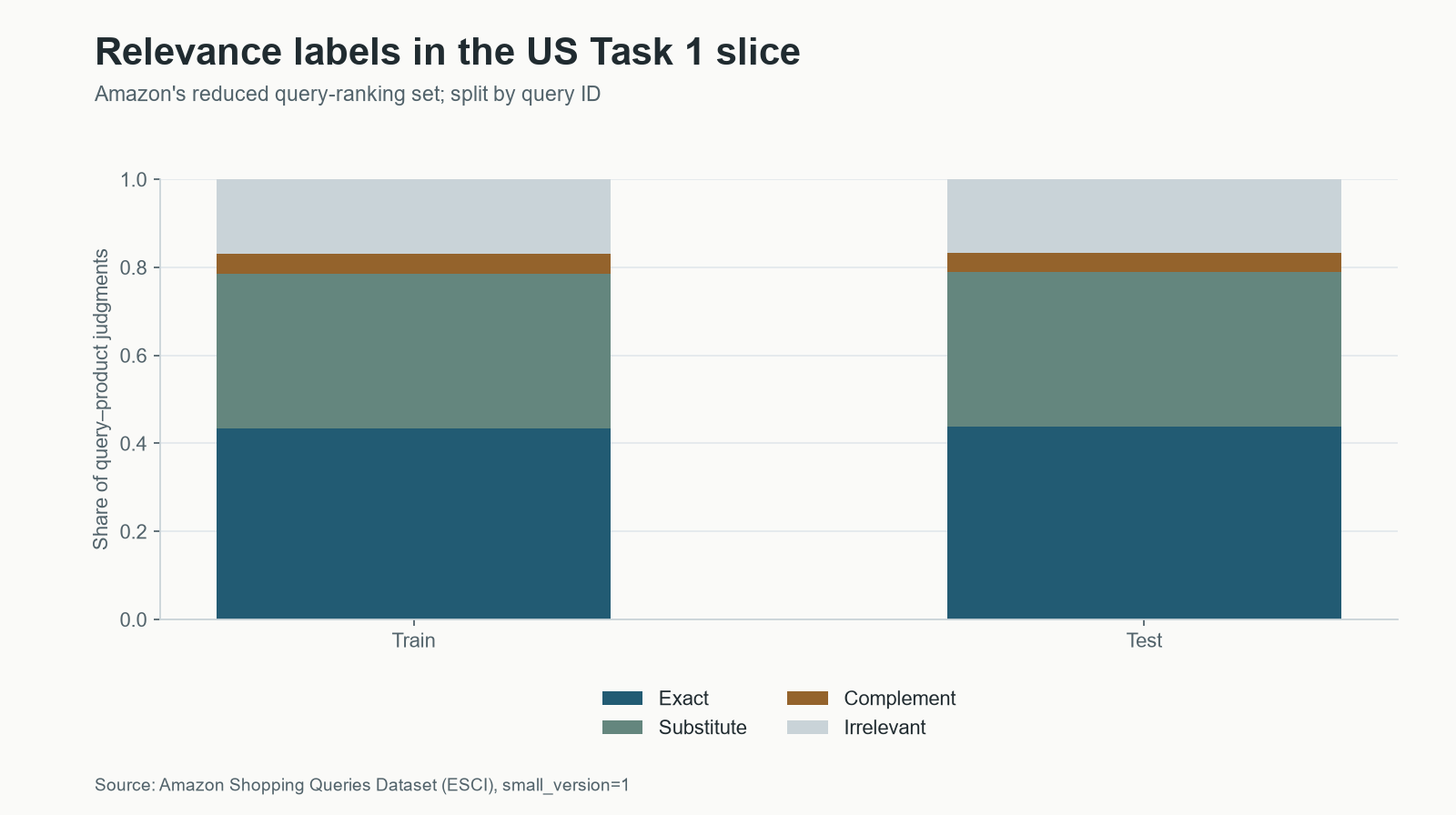
I used Task 1's reduced small_version and the US marketplace. The slice contains 601,354 query–product judgments across 29,844 queries: 20,888 training queries and 8,956 held-out test queries. Each query has a preselected list of judged candidate products. The examples and product metadata are from Amazon Science's 2022 release, which is licensed under Apache-2.0.
The examples and product records are joined on both product_locale and product_id. All 482,105 candidate products had metadata rows. Several text fields were blank: descriptions were missing for 47.8% of these products, colors for 32.2%, bullet points for 13.2%, and brands for 5.6%.
Method
The title-only baseline ranks candidates by IDF-weighted query-token coverage in the product title. The second score adds coverage in the product's bullet points, description, brand, and color.
To select field weights without looking at test labels, I split the provided training queries into 16,710 calibration queries and 4,178 tuning queries using seed 42. I estimated query-token IDF on the calibration subset, then selected a small field-weight grid on the tuning subset. The selected score used title weight 1.0, brand 0.5, color 0.5, and zero weight for bullets and descriptions. Product ID breaks score ties in a stable order.
The official metric is query-macro nDCG using Amazon's published gains: Exact 1, Complement 0.1, Substitute 0.01, and Irrelevant 0. I also report nDCG@10 as a local top-ten view, not the official full-list metric.
Findings
The added fields make a small difference
On the held-out queries, title-only matching scored 0.7965 full nDCG and 0.6670 nDCG@10. The train-tuned field score reached 0.7982 and 0.6709. A paired bootstrap over the 8,956 test queries put the full-nDCG change at +0.0017 (95% interval +0.0006 to +0.0030) and the nDCG@10 change at +0.0038 (+0.0024 to +0.0055).
The gains are consistent but modest. The selected weights retained the title signal, added small contributions from brand and color, and gave no weight to bullet or description text.
Exact matches occupy about half of the top ten
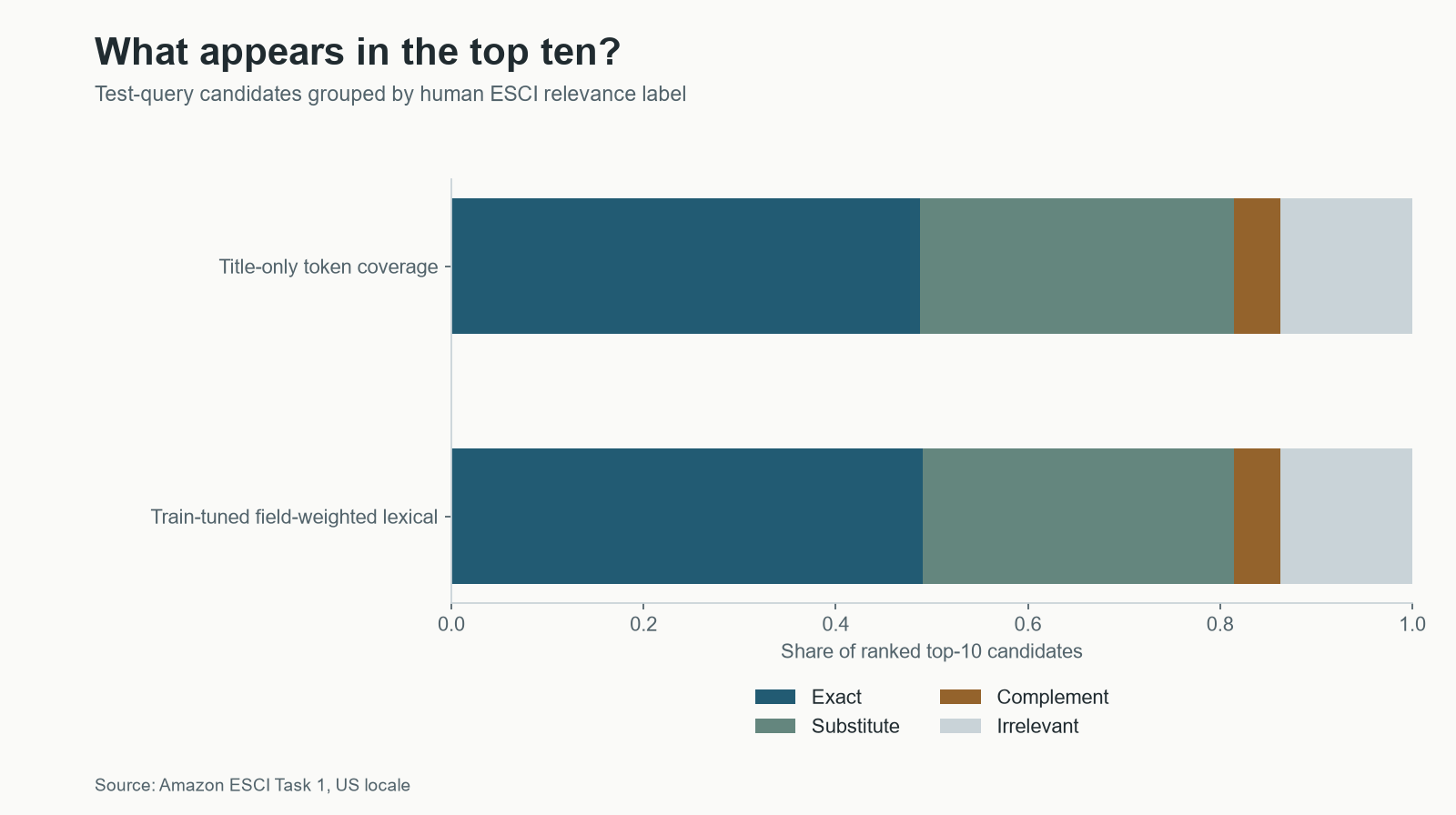
In the title-only top tens, 48.7% of ranked candidates were Exact and 13.7% were Irrelevant. The field-weighted top tens were 49.0% Exact and 13.8% Irrelevant. The similar mix reinforces that adding metadata fields changed ranking quality only slightly.
Train and test queries have similar label mixes
The Task 1 split includes Exact, Substitute, Complement, and Irrelevant judgments in both the training and test queries. Keeping these classes visible matters: a substitute can help a shopper, while an irrelevant result should fall below a useful result.
Recommendation
Keep title matching as the main lexical signal, then test small brand and color boosts in a controlled search experiment. This benchmark supports a modest offline ranking gain; it cannot tell whether shoppers see the candidates or whether the rank change improves clicks, purchases, or sales.
What this can't tell you
This 2022 benchmark reranks preselected candidates; it does not test full-catalog retrieval. It has no live impressions, clicks, purchases, sales, or margin, so the offline gain cannot establish shopper or business impact.
Read technical details
Technical notes
The analysis uses the provided query-disjoint split. Field weights are selected on train queries; test labels are used only for the final scores. The official Amazon scorer maps qrel grades E=4, C=3, S=2, I=1 to gains 1, 0.1, 0.01, and 0, respectively. nDCG@10 is an additional local metric. Source-file hashes, pair counts, evaluation results, and chart hashes are recorded in the evidence manifest. Reproduction instructions are in the project README.